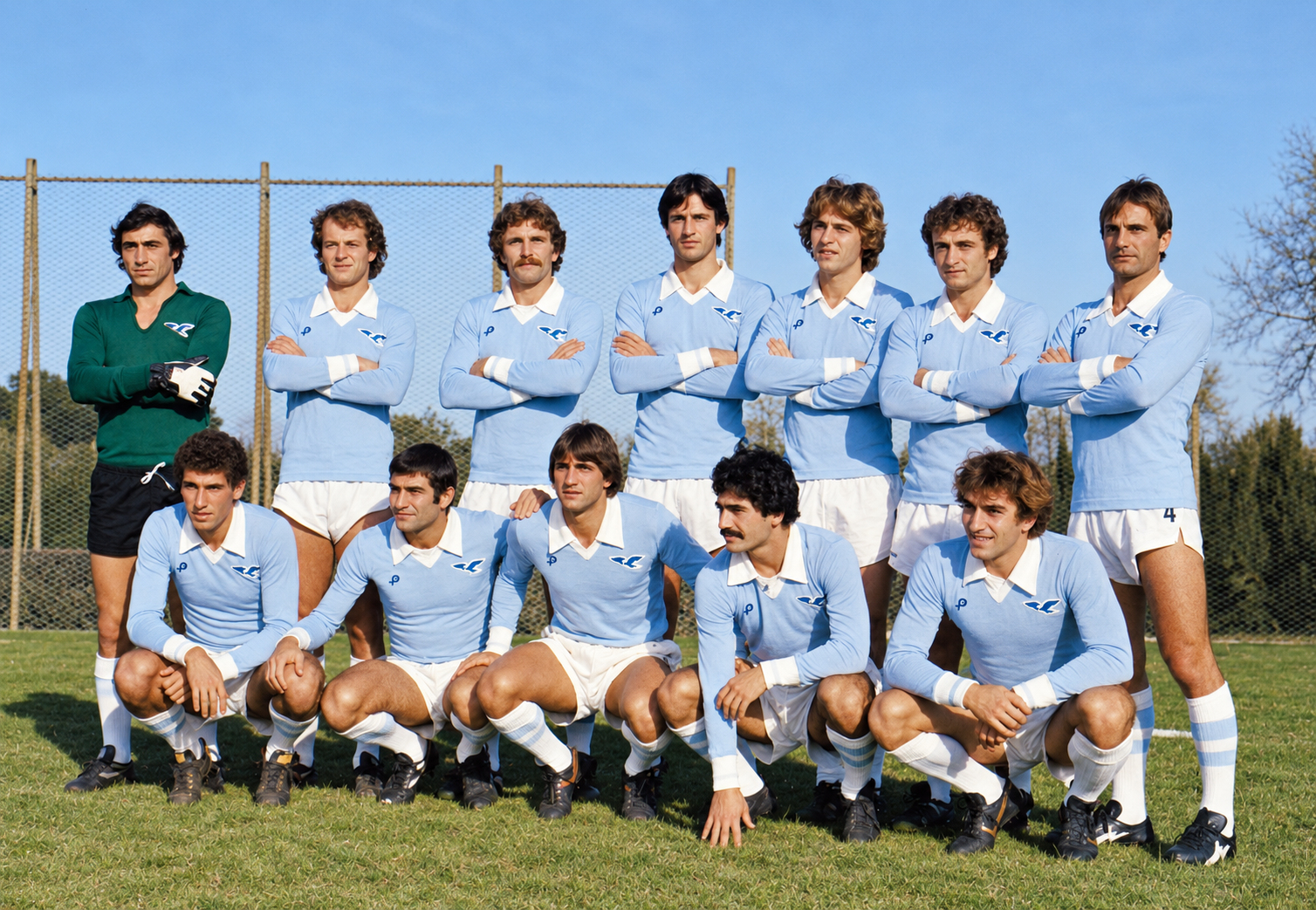

Pouchain x Lazio
In the 1979-1980 season Pouchain replaced Ennerre as the kit supplier of Lazio. Pouchain produced three shirts with unique designs: the light blue, the white and a brand new red one. The Pouchain P and the stylized eagle were embroidered directly on the fabric of the shirts.


In the 1979/80 football season, Italian club S.S. Lazio underwent a quiet but radical transformation—not on the pitch, but on their shirt. That season marked the first and only time Lazio’s iconic eagle crest was replaced by a stylized graphic reinterpretation: a full-body, wide-winged eagle now known among fans as the “Aquilotto” (“little eagle”). Behind this shift was a rising technical sponsor: Pouchain, an innovative Italian sportswear brand that had already turned heads with its bold designs for AS Roma. While the Lazio–Pouchain collaboration lasted only one year, it stands out in football history as a rare and striking departure from club tradition—a visual revolution that would later gain cult status.
Lazio in transition: Late 1970s context
By the late 1970s, S.S. Lazio was a club in flux. Following their historic Serie A title win in 1974, the team faced a mix of underwhelming performances and internal uncertainty. In this context, aesthetic modernization became an appealing strategy—a way to refresh the club’s image and identity, especially as Italian football began embracing new commercial opportunities.
The 1978 ruling by Lega Calcio allowing kit manufacturers to place small logos (up to 12 cm²) on shirts opened the door for new players like Pouchain to enter the scene. Lazio’s decision to partner with them for the 1979/80 season seemed bold, if not experimental.
The design: The birth of the Aquilotto
The most radical element of Pouchain’s Lazio kits was the replacement of the official club crest. In its place, a new graphic eagle appeared: a wide-winged, symmetrical silhouette—more emblematic than heraldic, more modernist than mythic. It was positioned directly on the chest, embroidered or printed into the fabric, often flanked by the black Pouchain “P” logo.
For Lazio fans, the Aquilotto evoked a range of reactions: admiration for its elegance and minimalism, but also disorientation at the disappearance of the beloved golden eagle-on-shield, which had long defined the club’s identity.
The Kits: Clean, colorful, controversial
Pouchain produced three shirts for Lazio that season:
- A light blue home kit, simple but sleek, with white accents and the Aquilotto emblem.
- A white away kit with blue trim.
- A surprising third kit in deep red, rarely used but highly collectible today.
Each shirt was cleanly constructed and followed the Pouchain philosophy of merging Italian tailoring with branding minimalism. For many supporters, however, the kits felt stylistically detached from Lazio’s identity. The design may have been ahead of its time—but it was not universally embraced.
Cult revival and rediscovery
Though short-lived, the Aquilotto era did not fade into obscurity. Decades later, retro collectors and kit historians began to reevaluate Pouchain’s Lazio designs. The shirts reappeared in fan auctions, museum exhibits, and club tributes.
In 2023, Lazio even launched a commemorative fourth kit inspired by the original Aquilotto design—an official recognition of a visual experiment once abandoned, now revered.
The partnership between Pouchain and Lazio may have lasted just one season, but it symbolized something much greater: a moment when innovation collided with identity, when Italian football took its first steps toward the modern visual culture we know today. Pouchain’s bold intervention—replacing a century-old crest with a minimalist eagle—was a break with tradition, and for some, a mistake. But it was also a sign that the beautiful game was entering a new era, one where style, branding, and symbolism would share the stage with sport.